Fibre for longevity

Daily ritual for lifelong colon health.

  • 8 g fibre
  • 8 ingredients

The founding pilot

Request an invite.

A closed founding group of 100 in Bengaluru. Leave your details and we’ll be in touch as places open.

~90%
of us fall short on fibre
~16g
average daily intake
30–40g
the daily target (ICMR-NIN)

You already know the gap. Here's what you don't.

Most prebiotics don’t ferment across the whole path.Buta-8 brings Smart Diversity — designed by function, not ingredient count.

ProximalThe start of your colon. Most fibre is spent here.
DistalThe far end. Where almost nothing arrives still working.

The Buta-8 Fibre Spectrum. Every gram has a role.

Smart Diversity, made visible: fibres chosen across three complementary layers.

Physical

Gel and bulk — how fibre holds water and keeps you regular

Microbial

Fermentation — the fibres your gut bacteria feed on

Botanical

Whole-plant variety — pulp, polyphenols and minerals

Tap a fibre — each does a different job

The fast feeder

Chicory inulin (Cichorium intybus)

Ferments
Fast
Fibre type
Soluble
Specialty
Prebiotic boost

Simple fructose chains that ferment fast and early — a strong, rapid prebiotic for Bifidobacteria. Because it ferments quickly it can produce gas, so it’s best built up gradually.
The butyrate driver

Resistant potato starch (Solanum tuberosum)

Ferments
Moderate
Fibre type
Resistant
Specialty
Butyrate

Resists digestion and reaches the colon intact, where it’s among the more butyrate-favouring fibres — feeding the bacteria that produce butyrate, the short-chain fatty acid that fuels the cells lining your colon. It ferments gradually, so it tends to be gentle on gas.

The gentle one

Acacia (Acacia senegal)

Ferments
Gradual
Fibre type
Soluble
Specialty
Gentle · low-gas

Soluble but complex and highly branched, so bacteria break it down slowly — a more gradual fermentation profile rather than a burst. One of the best-tolerated fibres for sensitive stomachs.

The regulator

Psyllium husk (Plantago ovata)

Ferments
Gel-first
Fibre type
Soluble · viscous
Specialty
Regularity

Swells into a thick gel that works both ways — softens hard stool, firms up loose. It’s primarily gel-forming and less rapidly fermented than the others, so it supports regularity without a sudden gas spike. Its viscosity is the most-studied of these fibres in human trials.

The all-rounder

Baobab (Adansonia digitata)

Ferments
Mixed
Fibre type
Soluble + insoluble
Specialty
Polyphenols + nutrients

Whole fruit pulp with a naturally balanced mix of roughly half soluble, half insoluble fibre — plus polyphenols, vitamin C, potassium and magnesium that isolated fibre powders lack.

The slow-carb gel

Jamun (Syzygium cumini)

Ferments
Mixed
Fibre type
Soluble + insoluble
Specialty
Slow-carb gel

Soluble pectin forms a gel that slows how fast carbohydrates digest; insoluble cellulose adds bulk. Its deep-purple anthocyanins are polyphenols studied for antioxidant activity. (Metabolic effects are largely preclinical — mechanism, not a product claim.)

Made to be the fibre you keep.

Gentle by design

Fibres paced across the spectrum so fermentation spreads out, instead of arriving in one gassy spike.

Nothing hidden

Every gram of every fibre named on the pack. No proprietary blend.

Real diversity

Four fibre classes and two botanicals, so you feed a range of gut bacteria rather than one.

Easy to drink daily

Light, low-calorie, lightly sweetened with monk fruit. A scoop you’ll actually keep reaching for.

New to fibre? What fibre does in your gut

Feeds your gut bacteria

Fermentable fibres are food for the microbes in your gut. That’s what a prebiotic is.

Nourishes the colon lining

Fermentation produces short-chain fatty acids that nourish the cells lining your colon.

Supports regularity

Soluble, viscous fibre adds bulk and supports comfortable, regular digestion.

Helps you feel full

Fibre adds bulk and slows digestion, which can help you feel full between meals.

Independent, ingredient-level evidence for dietary fibre. These are not claims about Buta-8 itself, which hasn’t been clinically tested yet. Not a substitute for a fibre-rich diet.

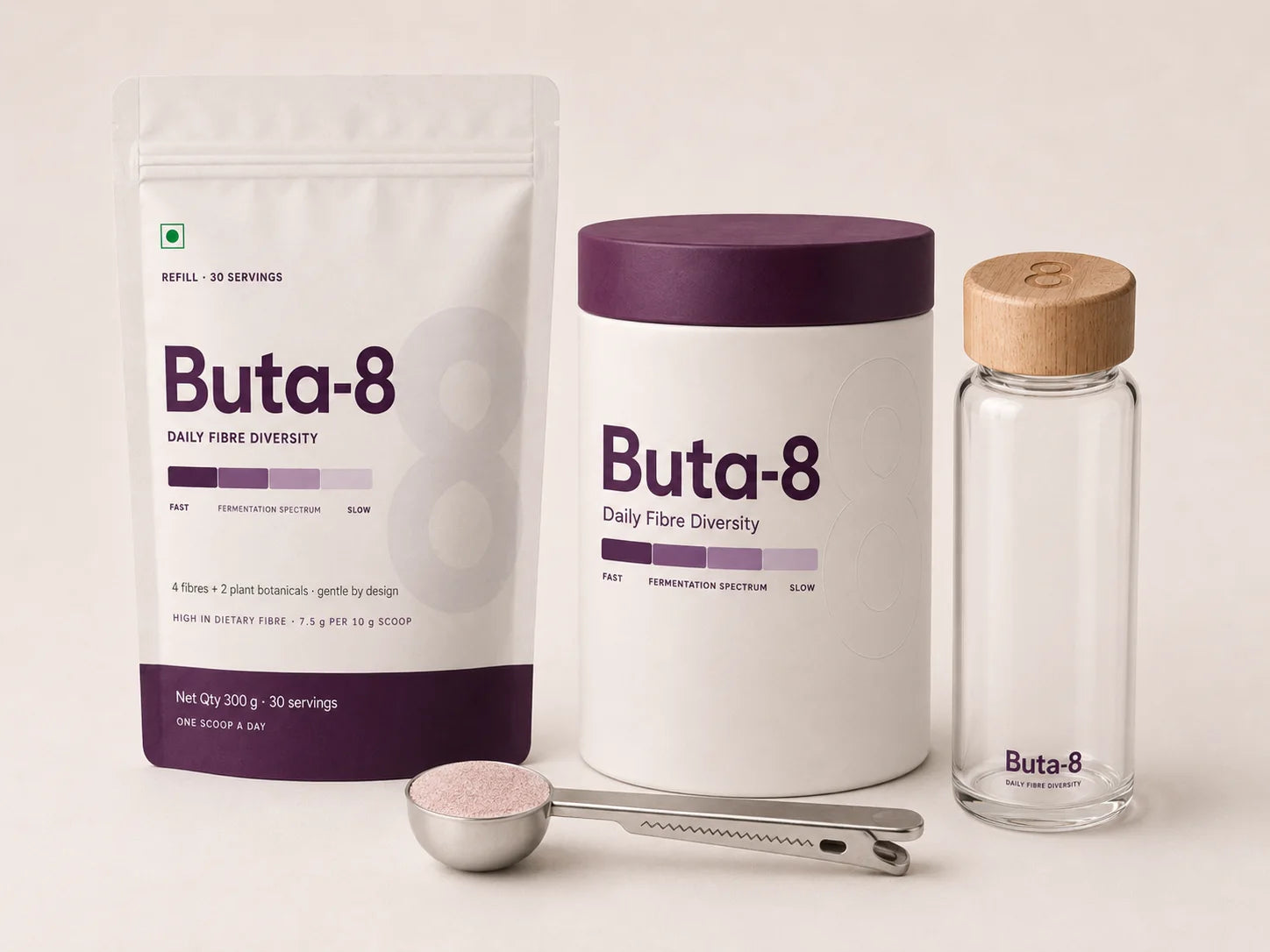
Buta-8 refill pouch, steel scoop-clip and glass shaker, shown with the steel canister that follows later

Your first order is the refill pouch, steel scoop-clip and glass shaker. The steel canister pictured isn’t part of the kit — we send it later, as a thank-you for staying with us.

What you get

  • The first batch, before anyone else
  • A hand in shaping the final blend
  • A direct line to the founder
  • Progress notes as the blend is finalised

What we ask

  • Take it daily through the pilot
  • A couple of minutes of honest feedback each week
  • Tell us what works — and what doesn’t

The founding pilot · Bengaluru · 100 members

Built with the founding group.

A closed group of 100 in Bengaluru — first to get the batch, a hand in shaping the final blend, and the honest job of telling us whether it sticks.

How the pilot works

One hundred places, open now.

01

Request an invite

02

We write back with the details

03

You take it daily for three months

The founding pilot is paid. Exact terms come with your invite, while the blend is being finalised.
Founding welcome kit included Free shipping Cancel anytime Every gram disclosed, no proprietary blend Gentle ½-scoop ramp to ease in FSSAI-licensed · batch-tested

Sold by Akunka Foods Pvt Ltd · FSSAI 11225302000121.

Built for anyone short on fibre — sharpened for two.

On a GLP-1

Eating less shouldn’t mean feeding your gut less.

On a GLP-1 you’re eating less, so your gut gets less of the fibre it runs on, right when it needs it most. Buta-8 keeps diverse daily fibre going and supports regularity. We won’t pretend to be Ozempic; we’re the fibre your gut needs while it works.

Longevity-minded

Fibre is the input. Butyrate is the point.

Diverse fibre feeds the microbes that make butyrate, the fuel your gut lining runs on and a molecule healthspan research keeps circling back to.

Also for

Low-fibre eaters

Also for

Gut, satiety & regularity

Also for: athletes, daily-habit buyers, and anyone swapping sugary snacks for functional nutrition.

Worth asking of any daily fibre.

Six questions. Ours included.

The questionButa-8A typical fibre powder
How many kinds of fibre? Four, plus two whole fruits Usually one
How far down does it work? Start to end of the colon Mostly the first stretch
Are the grams of each ingredient shown? Every one, on the pack Rarely — often a blend
Is there a gel-forming fibre for regularity? 3.5 g psyllium, the largest ingredient Often none
Is it built to ease in? Half-scoop first week, by design Full dose from day one
Is every batch tested? Identity, purity, heavy metals, microbes Varies

Comparison is with the fibre-supplement category in general, not with any named product. Sold by Akunka Foods Pvt Ltd · FSSAI Lic. 11225302000121 · Made in India. Not for medicinal use; does not diagnose, treat, cure or prevent any disease; not a substitute for a varied, fibre-rich diet. See the full science →

From the founder

I got into fibre when I realised how much it does beyond keeping you regular, right down to how gut bacteria turn it into the fuel our colon cells run on. The deeper I went, the clearer one thing got: dose gets you started, but design is what makes a blend work. Your gut doesn’t want a lot of one fibre. It wants a range, paced to be gentle.

So I built the blend I’d actually keep taking: diverse, easy on the day, and honest about every gram.

— Ravi, founder, Akunka

Questions, answered.

Will it cause bloating?

It can, if you start too fast. That’s true of any fibre, and it’s the whole reason we build it up slowly. Start at half a scoop in week one, keep the water up, and most first-week gas or fullness settles as your gut bacteria adjust. The blend is also designed to be gentler than a single fermentable fibre: viscous psyllium is kept at or above the inulin, and psyllium taken with inulin produces less gas than inulin alone (Gunn et al., Gut 2022).

How should I start?

Half a scoop a day for week one, then work up to a full scoop if that sat well. Always take it in a full glass of water — fibre needs water to do its job.

When should I take it?

Morning is the simplest slot for most people, on an empty stomach with plenty of water. What matters more than timing is taking it consistently.

Why not just take psyllium (isabgol)?

Psyllium is excellent — it’s the backbone of Buta-8. But it’s good at one job, mainly bulk and regularity; it doesn’t do much to feed the bacteria deeper in your gut. Buta-8 keeps the psyllium and adds the fibres that cover the jobs it can’t. See the spectrum →

Why multiple fibres?

Different fibres have different structures, so they feed different bacteria and do different jobs — gel and bulk, earlier and later fermentation, plant variety. A range of complementary fibres covers more than any single one.

Is the finished formula clinically tested?

The individual ingredients have published human evidence; the finished Buta-8 blend has not completed its own trial yet. The founding pilot is where we gather real-world learning on tolerability, regularity and adherence — product learning, not a clinical efficacy claim.

Can I take it if I’m on a GLP-1?

Yes — and fibre matters more on a GLP-1, not less. Eating less means your gut gets less of the fibre it runs on. Buta-8 keeps diverse daily fibre going and supports regularity — and there’s real biology behind it: your gut bacteria turn fibre into the signals that trigger your body’s own GLP-1, the same pathway your medicine works on. It’s food, not a drug — it won’t replace anything your medicine does. Check with your clinician, start at half a scoop with plenty of water, and build up.

What does it taste and feel like?

Light and lightly sweetened with monk fruit, not chalky or overly sweet. Psyllium gels quickly, so shake it and drink it promptly rather than letting it sit.

Is it low-FODMAP?

No — it includes chicory inulin, which is a FODMAP. If you’re in a low-FODMAP elimination phase or your clinician has put you on that plan, talk to them first.

I already get fibre from dal and sabzi — why this?

Most Indian plates are strong on one kind of fibre and light on the rest — plenty of the bulking kind, much less of the fermentable kind your gut bacteria prefer. Buta-8 isn’t here to replace your food; it fills the part of the fibre gap a good thali usually leaves behind, in one scoop you don’t have to think about.

Who should not take it?

Don’t take it if you have difficulty swallowing, since psyllium swells in water. If you have a gut condition or take regular medication, check with your doctor before starting. It’s not a substitute for a varied, fibre-rich diet.

Keep exploring

Explore the Spectrum · The full science · The ritual · The Journal

A glass of Buta-8 fibre, freshly mixed

A founding pilot, by invitation.

Daily fibre for lifelong colon health — ~8 g, every gram shown, one scoop a day.

Closed founding pilot · Bengaluru · cancel anytime.

Founding pilot open — Bengaluru · 100 members.